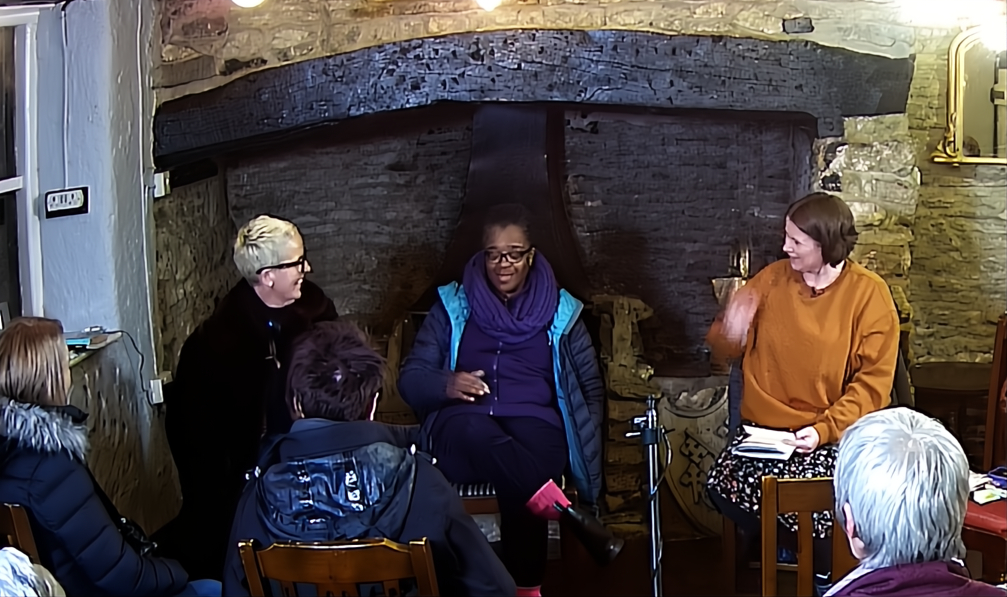
I co-curated and presented a series of Free Exchange events at a variety of locations in Northamptonshire.
These events were part of the Outdoor Institute of Art, an alternative art school conceived by Yasmin Canvin, with a curriculum consisting of discussions, skills, and knowledge-sharing events between artists, experts in relevant fields, the arts sector, and members of the public.
Each location of these Free Exchange events was chosen for its relevance to the topic of discussion.
Art + Wellbeing Free Exchange discussion with artist Filippos Tsitsopoulos and London Arts in Health Forum Director, Damian Hebron, discusses the growing interest in how the arts can improve the wellbeing of individuals and communities, and how and why artists use their own mental health as a conduit in their practice.
Reflecting on the historic relationship between arts, health and wellbeing, the discussion questions whether the current interest is a fad or is something more deep rooted in human nature; exploring the connections between wellbeing and art and how this relationship can be developed both as an artistic response and as a social healer.
Filippos Tsitsopoulus is a multidisciplinary artist who has been exploring the limits of theatre and painting since 1990, with installations and theatrical performances at Tate Modern, The Serpentine Gallery, FACT Liverpool, Alte Nationalgalerie (Berlin), and others. Earlier this year, his new project “Is Art Lonely?” was exhibited in Ostend, Belgium.
Damian Hebron has worked in the field of arts, health and wellbeing for fifteen years. He runs a successful hospital arts programme and established and developed the London Arts in Health Forum, where he is currently Director. Damian will reflect on the historic relationship between arts, health and wellbeing, questioning whether the current interest is a fad or something more deeply rooted in human nature; exploring the connections between wellbeing and art, and how this relationship can be developed both as an artistic response and as a social healer.
Recorded at Johnny’s Happy Place, Keystone Centre, Kettering, Northamptonshire.
JHP is a Community Interest Company run by 7 boards members. We are a not for profit, voluntary group. Everyone has mental health; some days it might be better or worse than others but like a diet, we all have it and we want to reduce the stigma surrounding mental health. JHP is open to everyone: old, young, rich, poor, good mental health, poor mental health.
Johnny’s Happy Place was set up to celebrate the life of Johnny. ‘Johnny was funny, talented, kind, compassionate and a wonderful human being. He was a very interesting and interested person but 2014 saw Johnny become more and more troubled. He would often run away from home, had many addictions and undiagnosed mental health problems. None of us could save Johnny and he took his life on October 23rd 2014. The darkest day of his and our lives.
Co-Curated with director of Fermynwoods Contemporary Art, James Steventon
Art + Landscape Free Exchange discussion, explores the relationship between materials and the landscape from which they are extracted. Originally taking place and broadcast from East Carlton Countryside Park, the discussion features artist Onya McCausland and Geologist Sue Barker.
Onya McCausland is an artist whose Turning Landscape Into Colour project investigates the origins of earth pigments found across the UK and considers their significance as contemporary cultural materials.
Onya explores the location, mapping and extracting of ochres from the landscape, and processing, manufacturing and naming individual sources of colour as vehicles for re-integrating people’s experience of places and establishing new connections between landscape and painting.
Sue Barker is a member of Northamptonshire Natural History Society‘s Geological Section, giving regular talks to members and co-leading a ‘Geology for Beginners’ course for the University of the Third Age. After studying Chemistry and Geology with Geochemistry and Geophysics, Sue has taught all three of the sciences in both state and private schools.
East Carlton Park is situated on the northern ridge of Northamptonshire, overlooking the Welland Valley. After discovering the rich seam of iron ore in the area, Stewarts and Lloyds Ltd established the steel works in Corby during the 1930’s, acquiring the grounds and hall at East Carlton to house workers. The grounds were later acquired by Corby Borough Council and have become a country park open to the public.
Co-Curated with director of Fermynwoods Contemporary Art, James Steventon and the late Martin Steed.
Art + Psychogeography Free Exchange discussion, exploring how environments can effect emotions and how walking can be seen as way to creatively explore different places, with a focus on the rural.
Artist Kate Genever and community walker Carole Wright, discuss how psychogeography inspires their practice, starting and ending up at The Cross Keys pub, with a short walk exploring the village of Kings Cliffe.
Art + Psycheography Free Exchange, November 12th, 2019
Kate Genever and Carole Wright discuss how environments can effect emotions and how walking can be seen as way to creatively explore different places, with a focus on the rural. Kate and Carole explore the village of Kings Cliffe discussing how psychogeography inspires their practice, starting and ending up at The Cross Keys pub.
Kate Genever is an artist and farmer based in South Lincolnshire on her family’s traditional mixed farm. She completed an MA at the Royal College in Printmaking and has been commissioned by organisations such as Yorkshire Sculpture Park, METAL Peterborough, The Wellcome Collection, British Council, Tate and Hull City of Culture. Much of her work sees her co-producing outcomes with individuals, groups, artists, curators and academics in diverse settings such as her family farm, a Yorkshire council estate, a women’s prison, Hull, a caravan park, Venice, and an asylum seekers charity.
Carole Wright is a community gardener, apiarist, walker and proud South Londoner from Brixton. She has won two awards from The Southbank Centre and The Peadbody Trust for her community work, and this year, Carole joined a team of community advocates to join ‘The Big Lunch Community Walk’, showing the importance of communication and how it can bring about positive change.
King’s Cliffe, is a picturesque village nestled in the heart of Northamptonshire. Steeped in history and rich in community spirit, King’s Cliffe offers a charming blend of rural tranquility and vibrant local culture. It is about 9 miles northeast of Corby in North Northamptonshire. The parish adjoins the county boundary with Peterborough. The village is not far from the Northamptonshire boundaries with both Cambridgeshire and Lincolnshire and is about 6 miles south of Stamford. Since 1999, Kings Cliffe Heritage group has researched and recorded their village heritage to create an accessible archive telling the story of King’s Cliffe and its people in the past’
Co-Curated with James Steventon, director of Fermynwoods Contemporary Art, and the late Martin Steed.
Videography and Live Feed, Martin Steed
Videography, James Steventon
Presenter, Emma Davies
November 12th, 2019
Introducing the Art + Psychogeography Free Exchange
With speakers Kate Genever (left) and Carole Wright (centre) within the Cross Keys pub, Kings Cliffe.
‘The Cross Keyes pub is almost 300 years old, and built using King’s Cliffe stone, a Jurassic limestone characterised by its warm golden colour. The name ‘Cross Keys’ is one of England’s most traditional pub names and refers to the sign of St Peter, the gatekeeper of heaven. Pubs with this name are often found near a church, such as here, as it was traditional for congregations to continue their ‘fellowship’ over refreshments after a church service’. Quote taken fromNorthamptonshire Walks
After each artist introduced their art practices, we set out on a guided night walk around Kings Cliffe.
Ellen Parker’s Blue Roundel, Kings Cliffe
King’s Cliffe has a ‘Who Was Here In 1911’ project, which is run by Kings Cliffe Heritage. This involved installing blue roundels on houses to commemorate residents who lived in Kings Cliffe during that year. This roundel celebrates the life of Ellen Parker, a widow. Her occupation was not recorded.
On the walk, we were accompanied by Sue, from King’s Cliffe Heritage who was able to provide an in depth historical account of Kings Cliffe and who occupied the houses which had the blue roundels.
An audience member, walking through ‘Rate’s Lane’
Kings Cliffe has a number of little lanes like this, which connect to streets and locations throughout the village. Rate’s lane connects West Street, with Church Walk and was named after a local resident.
Emma Davies and the audience holding still within the churchyard
November 12th was the night of a full moon, the ‘Frost Moon’, or the ‘Mourning Moon’, signalling the arrival of winter and the last full moon before the winter solstice. We stood for a few moments, in the churchyard of ‘The Church of All Saints and St. James’ to listen to the wind in the trees.
An audience member appreciating the songs of the wind
We thought about ‘Sense of Place’ and how places make us feel.
Carole Wright and Kate Genever, resting under a tree
This tree was planted in 1987 by the oldest resident of the village, Rose Latimer. It was in celebration of Kings Cliffe winning a ‘Best Kept Village Award’. It is also the site of the oldest settlement in the village.
Kate Genever and Carole Wright
Kate says ‘I’m loving this night time walk. It’s great!’
We’ve arrived back in The Cross Keys pub, for Carole, Kate and the audience to reflect on the walk; key moments, themes, feelings and atmosphere’s
The conversation traversed thoughts around mapping, experiences these moments rather than trying to photograph them, and, led to a comparison between walking through Kings Cliffe, and Carole’s experiences of walking through London.
Carole:
Walking at night through a village I’ve never been to * Being nosey into people’s windows* Walking through a narrow lane * The feel underfoot * Using your peripheral vision* Taking in the details * Walking through the graveyard “My family would say ‘This is duppy business’! This is a Jamaican expression. ‘Why you go walking past people’s graves at night?’ It’s kind of like a taboo. This makes me very excited and happy to report this back to my family later!” * Want to come back in the daytime to look at the nooks and crannies * Community Gardens in London are likened to ‘leaning on the garden fence’ * Community Gardens are our villages, where you get to find out about the mental, physical and spiritual wellbeing of the occupants of the block of flats, as they are isolated and not with their community* Stop and Listen (to the birds) * Communal knowledge * Mapping Blackfriars and painting knowledge onto people’s faces (with face paint)
Kate:
* Walking at night, to enjoy how you see a place differently * Looking through the trees as the moon comes out * These things are impossible to photograph, but you have to love these moments with your eyes, when you don’t have a camera, and forced into a position to remember these things * Loved standing in the orchard, talking about three year old trees, it’s the way forward! * How to share histories and observations *Paying attention to a place in different ways * Isolation in villages * My job as an artist is to introduce people to look differently, to see things anew
Audience:
* The difference between Kennington and Kings Cliffe * To Carole – can you find solitude in a city? * “It’s this time of night. It’s walking through; whilst dark or early in the morning. And it’s where. You can no longer find it in the City of London. Go to the outskirts. Blackfriars, it’s so quiet. You can hear the Thames. Follow the rivers. Then when Extinction Rebellion were reclaiming the City of London Bridge and people are playing cricket, within the gaze of the Houses of Parliament” *
Emma:
*Different appreciations of the word ‘Pyschogeography’, but all had that experience tonight on different levels * The history of the village * It’s ‘Sense of Place’ * Differences in cultural experience of place * City of London v Kings Cliffe, what is experienced in London, is different to what’s experienced here * walking, talking, sharing, community * individual as well as group feelings and connections to and of a place
We ended ‘Art + Psychogeography’ with Carole’s phrase ‘Knowledge onto people’s faces’.
I co-curated a series of online workshops with director James Steventon, ‘which aimed to keep spirits buoyed and creativity alive during COVID-19 social distancing and quarantining measures’ Each artist was commissioned to create an art workshop that people were able to do at home, using materials and equipment they might have at home.
Used to distinguish new sessions and visits. This cookie is set when the GA.js javascript library is loaded and there is no existing __utmb cookie. The cookie is updated every time data is sent to the Google Analytics server.
30 minutes after last activity
__utmc
Used only with old Urchin versions of Google Analytics and not with GA.js. Was used to distinguish between new sessions and visits at the end of a session.
End of session (browser)
__utmz
Contains information about the traffic source or campaign that directed user to the website. The cookie is set when the GA.js javascript is loaded and updated when data is sent to the Google Anaytics server
6 months after last activity
__utmv
Contains custom information set by the web developer via the _setCustomVar method in Google Analytics. This cookie is updated every time new data is sent to the Google Analytics server.
2 years after last activity
__utmx
Used to determine whether a user is included in an A / B or Multivariate test.
18 months
_ga
ID used to identify users
2 years
_gali
Used by Google Analytics to determine which links on a page are being clicked
30 seconds
_ga_
ID used to identify users
2 years
_gid
ID used to identify users for 24 hours after last activity
24 hours
_gat
Used to monitor number of Google Analytics server requests when using Google Tag Manager
1 minute
_gac_
Contains information related to marketing campaigns of the user. These are shared with Google AdWords / Google Ads when the Google Ads and Google Analytics accounts are linked together.
90 days
__utma
ID used to identify users and sessions
2 years after last activity
__utmt
Used to monitor number of Google Analytics server requests